
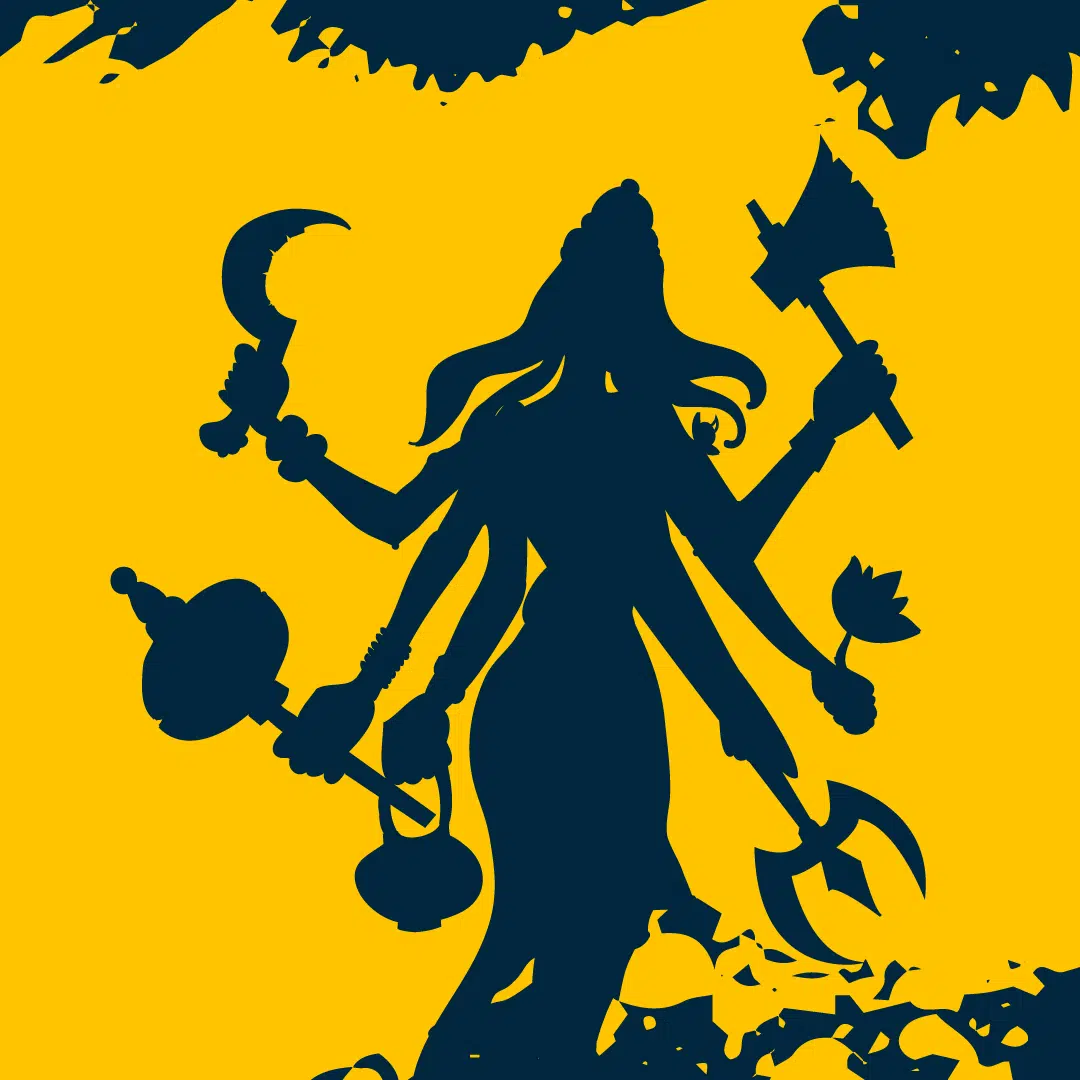
Navratri is a 9 day-long festival that is celebrated in India. Navratri is the celebration of Devi Durga and her 9 forms. Devi Durga is also synonymous with Adi Shakti. Adi Shakti means energy, power, and empowerment. Adi Shakti celebrates the female energy of the universe. The energy that brings about equilibrium and balance. The nine forms of Devi Durga – 9 goddesses of Navratri – are Maa Shailaputri, Maa Bhramacharini, Maa Chandraghanta, Maa Kushmanda, Maa Skandamata, Maa Katyayani, Maa Kaalratri, Maa Mahagauri, and Maa Siddhidatri.
Day 1: Navratri Story: Maa Shailaputri
Maa Shailaputri is the goddess that is worshipped on the first day of the nine-day-long Hindu festival of Navratri. Shailaputri means the daughter of the mountains. Before she was born as Shailaputri, she was born as Sati. The daughter of Daksha Prajapati, one of the sons of Lord Brahma. Sati was in love with Lord Shiva and she really wanted to marry him but her father Daksa Prajapati was absolutely against this marriage. According to him Shiva was a dirty ascetic not meant for marrying girls from respectable families but this did not affect Sati’s love for Shiva and she married him even though her father was against it and she started living with Lord Shiva in Kailash Parvat.
After a few years of her marriage, she got to know that her father Daksa Prajapati was organizing a huge yajna in which all gods and goddesses were invited. She was very excited because she missed her parents and she wanted to go home and visit them but unfortunately they did not receive an invitation. Sati could not believe it and she thought maybe there was a mistake. Maybe it was obvious, you know, daughters are always welcome in their homes, aren’t they? So she decided to go and visit her parents even though Shiva really tried to tell her that, ‘No if we haven’t received an invitation maybe we are not expected there and we shouldn’t be going there.’ But Sati did not listen. She did not pay heed to Shiva’s words and she went home. She was excited to meet her parents after so many months of being married and the moment she reached she received a cold shoulder not just from her father but also from all the relatives who had gathered there. It was only her mother who welcomed her and embraced her but Sati was heartbroken she could not bear the thought of being unwelcome in her own house. The very same house where she grew up, the very same house where she had those lovely memories and her own father, who she loved so much, humiliated her, humiliated her choice of husband. Sati could not bear it and she entered the huge fire that was burning and she self-immolated herself.
The moment this news reached Shiva he was livid and he reached there. He was so angry that he pulled the half-burning corpse of his wife from the fire. He was so enraged that he took the form of an angry god Veerabhadra and caused immense destruction over there, so much so, that he even beheaded Daksha Prajapati. He took the half-burning corpse of his wife with him dragging it in fury, in rage. On the way, different body parts of Sati fell on different places and these places are called Shakti Peethas. There are 52 Shakti Peethas in India. Daksa Prajapati was later forgiven because of the intervention of Lord Vishnu and he was given the head of a ram. He even completed his Yajna in the presence of all the gods.
Sati took birth again and this time as the daughter of the Himalayas. She came to be known as Shailaputri, which means daughter of the Himalayas. In the same incarnation, she had two other names Parvati and Hemavati and in this birth too she was married to Lord Shiva. Shailaputri is considered one of the most powerful forms of Durga and we pray to her on the first day of the Navratri festival. She is immensely powerful, she rides a bull called Nandi and she carries a trident and a lotus. She’s known for her many many glories.
Day 2: Navratri Story: Devi Brahmacharini
Devi Bhramacharini is a form of goddess Durga that is celebrated on the second day of the 9 day long festival of Navratri. After her self-immolation in her previous birth as Sati she took birth again and this time she was born to the king of the mountains, The Himalayas. In this birth she came to be known as Parvati and in this birth Parvati became Bhramacharini. ‘Bhram’ over here means tapasya and ‘charini’ means a female devotee – an ardent female devotee. One day Parvati was visited by Narada Muni-ji. Narada Muni-ji told her that, ‘In this birth too you can get married to Lord Shiva but for that, you will need to do severe penance.’ At once Parvati decided that she was ready for any kind of penance. She went into severe penance. It was no ordinary tapasya, her tapasya went on for thousands and thousands of years. For the first thousand years, she only ate fruits and flowers, for the next hundred years, she only ate vegetables, for the next three thousand years she only ate dried leaves. This kind of tapasya or penance was different. Nobody had ever seen this kind of tapasya and after the 3000 years where she ate only leaves she went on to eating nothing. She gave up water, she gave up food and her purpose of life became severe penance. She became weak and absolutely emaciated. Once when her mother visited her she was shattered to see her and she remarked, ‘Oh! ma.’ It is because of this remark that sometimes Parvati is also known as Uma. When she gave up eating leaves she earned herself another name – the name is Aparna – somebody who lives without the leaves. After so many years of penance, Lord Brahma was pleased and he visited her and blessed her saying that due to her penance Lord Shiva too was pleased and they had Lord Brahma’s blessings and the both of them could get married in this birth. Bhramacharini is the symbol of immense sacrifice, penance, solitude, purity. On the second day of Navratri, we pray to her to give us so much strength that we can be completely focused on penance towards God, what we love and towards sacrifice, and towards solitude. In this form, she carries a rosary in one hand and a commandal in the other. People pray to her for peace, prosperity, and happiness. A lot of people who follow the Navratri also observe a fast for all nine days. They go without food and sometimes even water. On those days they pray to goddess Bhramacharini for strength so that they can stay focused and so that they can deal with whatever they wish for.
Day 3: Navratri Story: Devi Chandraganta
On the third day of the auspicious celebration or festival of Navratri, we pray to Devi Chandraganta. Chandraganta, the goddess whose forehead is bedecked with a crescent-shaped moon that also looks like the bell of a temple. Which is the ‘Ghanta’. How did Chandraganta get her name? How did Devi Durga in this form take another avatar?
In one of her previous births, Devi Durga was born as Sati and she has self-immolated herself. When she was born again, she was born to Himavan and Mena, the God of the mountains. It is said that Himavan and Mena had done severe penance and prayed to Aadi-Shakti and Devi Durga herself took birth as their daughter, Parvati. And Parvati on the insistence of Narad Muniji went into a severe penance to win the love of Lord Shiva and then after a severe penance Lord Shiva agreed to marry her. However, after he had lost Sati, Lord Shiva had become detached. He did not care any longer about anything. So when he came down to Himavan and Mena’s house for the wedding ceremony, he appeared to look really, really scary. With his matted hair, his body covered in ash, snakes all over his body. His looks scared all the people who had assembled there for the wedding. And so much that his wedding processions comprised ascetics, ghouls, ghosts. Some of the relatives of Himavan and Mena even fainted out of sheer fear. When Parvati saw him, she was upset, yes, she was scared too. But she did not want to give up, not now, not after that severe penance that she went through. So she took a very very scary form too. She was huge, she was sitting on a lion and she grew ten arms and she carried a different thing in each hand, a trident in one, a mace in one, an arrow, a bow, a sword, lotus, goad, bell, kamandal and she left her tenth hand to bless her devotees. And then she closed her eyes and with a pure heart, she prayed to Lord Shiva and begged him to change his avatar. To change his form, to come there as a more presentable groom and also to bring along a more presentable procession.
Lord Shiva heard her prayers and at once transformed into his handsome avatar. And his wedding procession, too, transformed and comprised gods, goddesses, devas, devis. And both of them were married with a lot of pomp and show. Since that day, the third day of Navratri, we celebrate and pray to Maa Chandraganta, the third avatar of Devi Durga, Aadi Shakti Devi Durga.
It is said that when devotees pray to Maa Chandraganta with a pure heart then she eradicates all negative energy from their lives. All their sins, all the ghostly tribulations, anything that is negative, their depression, their mental anxiety, tribulations and troubles are all wiped out. When she rides a lion, she exudes positivity, she exudes fierceness, yet she has the motherly aura. towards her devotees.
Day 4: Navratri Story: Maa Kushmanda
Maa Kushmanda is the Goddess of a form of Durga that is worshipped on the fourth day of the 9-day-long festival of Navratri, which is celebrated in India. Maa Kushmanda is also known as the smiling Goddess. Her name translates into three small words – ‘Ku’ means little. ‘Ushma’ means small and smiling and ‘Anda’ means egg which translates into a small cosmic egg. It is believed that is was Maa Kushmanda who actually created the universe. In the beginning, when there was nothing and there was only darkness, that’s when Maa Kushmanda using her energy produced a small cosmic egg, which is the universe where we live.
It is believed that it is Maa Kushmanda who resides in the core of the centre of the sun and it is her that who gives the sun the direction. It is she who gives all universe warmth and energy. At the beginning of time when there was nothing, and after Maa Kushmanda had created the universe, she created 3 life forms – from her left eye she created a fierce Goddess called Maa Mahakali. From her third eye, from her forehead, she produced Maa. And from her right eye created a benevolent and smiling Goddess, Maa Mahasaraswati. And then she started glancing at these 3 life forms.
These three life forms, Mahalaxmi, Mahakali and Mahasaraswati were the first three life forms of the earth. She glanced at Mahakali. From Mahakaali a male and female were born. The male had 5 heads and 10 arms. She named him Shiva. The female has one head and 4 arms – she named her Saraswati. Then she glanced at Mahalaxmi. And from her too a male and a female were born. The male had 4 heads and 4 arms – she named him Brahma. The female has 1 head and 4 arms, she named him Laxmi. And then Maa Kushmanda glanced at Mahasaraswati. And from her too emerged a male and a female. The male had 1 head and 4 arms – she named him Vishnu. And the female too had 1 head and 4 arms – and she named her Shakti. And then she presented Shakti to Shiva, Saraswati to Brahma, and Laxmi to Vishnu as their consorts. It is believed that these 3 went on to create the rest of the universe. And then Maa Kushmanda absorbed the three back into herself. She absorbed Mahakali, Mahasaraswati, Mahalaxmi, all back into herself. And then it is believed that she became one with Shakti as an orb of energy, as an orb of form. And since then it is believed, Maa Kushmanda is the one that actually provides the entire universe with its warmth and energy.
On the fourth day of Navratri we pray to Maa Kushmanda and she removes all obstacles from the lives of her devotees. Maa Kushmanda has eight arms, and in these eight arms, she carries a kamandal, a bow, an arrow, a pot of nectar, a lotus, a rosary, a disc and a mace. She rides a lion and because of which her devotees are fearless like her.
Day 5: Navratri Story: Maa Skandamata
Maa Skandamata is worshipped on the fifth day of the nine day-long festival of Navratri. ‘Skanda’ means Kartikeya who was the firstborn child of Shiva and Parvati and ‘mata’ means mother so Skandamata essentially is the story of goddess Parvati. We all know that after Sati immolated herself, Shiva became completely disconnected from the world he lived away from everybody deep in tapasya and he did not care at all about what was happening. He lived as an ascetic.
Around that time there were two demons Surahpadman and Tarakasura and they had got a boon that they could not be destroyed. In fact, the only person who could kill them was the offspring of Shiva and Parvati. However when Shiva completely disconnected himself from the world, all the gods and goddesses got really worried, ‘What if they’ll never manage getting rid of the two demons Tarakasura and Surahpadman? And that’s when they all went to Lord Vishnu and begged him to find a solution. Lord Vishnu told them that it was absolutely their mistake. Had they not gone to Daksha Prajapati’s Yajna without Shiva and Sati being a part of it, this would have never happened. Sati would have never immolated herself and Shiva would have never been disconnected from everybody. So Vishnu had no solution. That’s when Narad Muniji went and told Parvati, who had taken birth again, she was another incarnation of Sati, and this time she was born to the god of the mountains. Narad Muniji visited Parvati and told her that in this life too – she could get married to the love of her life, which is Shiva, however that would require severe penance, severe tapasya. Parvati really wanted to get married to Shiva and she went through thousands and thousands of years of tapasya – severe penance, after which Shiva was finally pleased he relented. And they both got married.
When their union happened a blinding seed – a powerful seed – took birth. This seed was so radiant that Lord Agni himself was given the job of taking care of the seed because from its radiance the child of Shiva and Parvati would be born. However, Agni could not bear the radiance of the seed and he took help from Ganga. Ganga looked after the seed and then Parvati herself took the form of water because she knew that only she could carry the seed that was born of her union with Shiva. And then Kartikeya was born. He had six faces and he was looked after by six mothers also called ‘Krittikas’ which is how he got the name of Kartikeya.
In south India, Kartikeya is also known as Lord Murugan. He’s the commander-in-chief of the Army of Gods. He is ever so powerful and he’s blessed by all gods and goddesses not just with powerful weapons but also immense knowledge.
It is said that when he grew up a little bit he went to Brahma himself to gain knowledge. And on the first day, he asked Brahma a question. He asked him the meaning of ‘Om’ and Brahma took 12,000 verses to explain him the meaning of but Kartikeya was not satisfied so he went to his own father Lord Shiva and asked him. Shiva explained the meaning of ‘Om’ in 12 lakh verses this but Kartikeya was not satisfied. But by now he had figured out the meaning of ‘Om’ and he explained it to everybody in 12 crore verses. That was Kartikeya – ever so powerful – which is why it is believed that if you pray to Skandamata you automatically end up praying to Kartikeya.
Skandamata has four hands. In one hand she carries Kartikeya as a baby, in her second and third hand she carries a lotus, and with her fourth hand, she blesses her devotees. Skandamata rides a lion and she sits on a lotus. Skandamata is believed to be the powerful mother of a powerful god and so she’s worshipped on the fifth day of Navratri.
Day 6: Navratri Story: Maa Katyayani
Maa Katyayani is worshipped on the sixth day of the nine-day long Hindu festival of Navratri. Maa Katyayani is one of the most popular forms of Durga who is prayed to during Navratri. It is believed that Maa Katyayani was born to kill and bring an end to Mahishasura. The story goes like this – There was once a sage named Katyayan and he was childless. And he prayed with all his heart to the Trinity Shiva, Vishnu and Brahma. He was blessed that one day he will have a wonderful child – a child will make him very very proud. In the meantime, Mahishasurah the demon was really really becoming powerful so much so that the Gods the devas also feared him and they all went to the trinity and begged them to find a solution. Shiva, Vishnu, Brahma combined their energies and created a female form. This female form was extremely radiant – as radiant as a thousand suns and she had 18 arms, she had fierce eyes, she rode a lion and was given the blessings to defeat Mahishasura in battle. Just before going into battle, all the gods blessed her with many gifts – Shiva gave her a mighty Trident, Vishnu gave her a Sudarshan Chakra, Brahma gave her a water-pot and a rosary, Varuna gave her a Conch / Shunk, Agni gave her a Dart, Surya gave her a Quiver, Vaayu gave her a Bow, Indra gave her a Thunderbolt, Kuber gave her a Mace, Kaal gave her a sword and a shield and Vishwa Karma gave her a Battle-Axe. She rides a lion and she is fierce. It is said that she went into a mighty battle with Maheshasura. The battle between Katyayani and Maheshasura went on for days and finally, she defeated him by chopping off his head. Katyayani is also known as Mahishasura Mardani the one who killed and defeated Maheshasura. And her celebration, her victory is celebrated in India. A day when a woman took a form that was fierce and she went down on earth and she defeated a demon who was as terrible as Maheshasura. Maa Katyayani has four hands – in one she holds a sword, in the other, she holds a lotus, with the third hand she blesses her devotees, and with the fourth hand, she protects them.
Day 7: Navratri Story: Maa Kaalratri
On the 7th day of Navratri, we celebrate the 7th avatar of Goddess Durga, Kaalratri (also spelt Kalaratri). She is also known as Shubhankari. Kaalratri is the fiercest form of Devi Durga. She is the destroyer of evil. Maa Kaalratri is black as night and has three luminous eyes. She exhales fire. She has four hands, in one she holds a thunderbolt, in the other she holds a sword. Some stories say that her other two hands lay in mudras- one in ‘abhay’, symbolising her fearlessness, and the other in ‘varada’, symbolising her benevolence. Some say that she uses one hand to hold and the other to protect. After the asuras Shumbha & Nishumbha invaded devlok and destroyed Indra’s kingdom, the devas were left helpless since these two asuras had a boon that no man or god could kill them. To save the devas from the terror, Indra visited Parvati and apprised her of the situation. Parvati sent Chandi, also known as Kaali, to deal with the demons. However, Shumbha & Nishumbha had sent two other demons called Chanda & Munda in the battlefield already. Chandi killed the demons and earned herself the name Chamunda. She then faced another demon called Rakhtabeej. Rakhtabeej had a peculiar and powerful boon. He could never be destroyed. Whenever Rakhtabeej’s blood was shed and it came in contact with the ground, a new Rakhtabeej would emerge. This infuriated Maa Kaalratri and as she struck him, she bent low and drank his blood before it could come in contact with the ground. That was the end of Rakhtabeej. Maa Kaalratri then went on to kill Shumbha and Nishumbha, restoring peace in Devlok.
Day 8: Navratri Story: Maa Mahagauri
On the eighth day of the nine day-long festival of Navratri, we celebrate and we pray to Maa Mahagauri. ‘Maha’ means extremely and ‘Gauri’ means fair. This is a story of Parvati-ji and once when Parvatiji in the form of Kaalratri was fighting all the demons and when she came back her skin had turned absolutely dark and try as she may she just couldn’t get rid of that dark skin. Her husband Lord Shiva made a little fun of her. He teased her and called her ‘kali’. However, this really really infuriated her and she went to Lord Brahma. She prayed and prayed to him and she told him that, ‘I want to get rid of this dark skin. Make me fair once again.’ After a severe penance, Lord Brahma was pleased and he blessed Parvati. He told her that she should go and take a dip in The Mansarovar Lake in the Himalayas. The moment Parvati stepped into The Mansarovar Lake in the Himalayas, her dark skin separated from her and magically took the form of a female. This female was called Kaushiki. Kaushiki went on to destroy two terrible demons Shumbha and Nishumbha. Shumbha and Nishumbha had got a boon from Lord Bhrama that they could not be killed by any man, god, demon or deity. And that’s how Kaushiki killed them.
Once Parvati had bathed in the river she emerged absolutely stunning. Her skin was now fair and radiant and once again she became the fair-skinned one and came to be known as Maa Mahagauri. Maa Mahagauri has four arms. She carries a trident in one hand and a damaru in the other. She rides a white bull. She is a symbol of kindness and morality. That was a wonderful story, wasn’t it? But then, it makes me think about something.
Tell me, is fair skin really a symbol of beauty? Is it important to have fair skin or a fair heart? I think Maa Mahagauri had an enormously courageous and beautiful heart and no matter what the colour of her skin was, she was the one who destroyed demons before and after.
Day 9: Navratri Story: Maa Siddhidatri
On the ninth day of the nine-day long Hindu festival of Navratri, we worship the ninth form of Devi Durga. The ninth form of Devi Durga is Maa Siddhidatri.
It is said that at the beginning of time when there was nothing in the universe there was only darkness then Maa Kushmanda created the universe using her radiant smile. Maa Kushmanda also created the holy trinity. She created Lord Shiva, Lord Brahma and Lord Vishnu and each one of these gods was given a job to do. Brahma is the creator, Vishnu the preserver and Shiva the destroyer. Once all these gods were created, Shiva went and prayed to Maa Kushmanda and asked her more perfection. He asked Maa Kushmanda to bestow him with lots and lots of blessings, to bestow him with more perfection. And that’s when Maa Kushmanda created another goddess. She created Maa Siddhidatri.
Maa Siddhidatri blessed Shiva not just with eight or ‘ashtasiddhis’ but with 18 siddhis or 18 perfections. These 18 comprised not just the ‘ashtasiddhis’ or the eight perfections but also ten more siddhis which are the secondary perfections as defined by Lord Krishna. And then something amazing happened, half of Lord Shiva’s body became one with Maa Siddhidatri. She became half of Shiva and that form of Shiva where he is half female and half male is called Ardhanareshwar.
Maa Siddhidatri also blessed Brahma and Vishnu with eight perfections or the ‘ashtasiddhis’ and these eight Siddhis (perfections) are:
- Anima: The ability to become as small as an atom
- Mahima: The ability to become infinitely large
- Garima: The ability to become infinitely heavy
- Laghima: The ability to become infinitely light
- Prati: The ability to become omnipresent
- Prakhambya: The ability to make all that you desire come true
- Ishitva: Lordship
- Vashitva: The power to conquer all.
And that is why Maa Siddhidatri is worshipped on the ninth day of the Navratri which is also called Ram Navmi or Naumi.
Maa Siddhidatri sits on a lotus and her ride is a lion. She has four hands. In one hand she carries a Gada, in one a chakra, in one a lotus, and in one a Shunk. Maa Siddhidatri is not just worshipped by humans she is worshipped by the devas, by the Gandharvas, by the asuras, by the yakshas, and by the Siddhas.

It was amazing !!
And honestly I don’t know about the 9 devis . So I just want to thank you for giving so a good knowledge about our culture.
Thank you. We are glad you found our post informative.
Learning about Navratri’s was commendable. such enriching videos. I used your videos to teach my students about all nine Devis.
Best wishes and May Godess Durga bless you forever!
Thank you so much for your appreciation. Glad you liked the videos and were able to share them with your students. Please do see our youtube channel. If possible do share it with your students. We create things out of passion and getting new viewers and subscribers is very encouraging 🙂 Thanks once again.
This was absolutely delighting to read your insightful article. Gained precious information. Thank you so much!
Thanks for this immense information.
I am really indebted to go through the ocean of knowledge with your illustration. Thanks a lot.
Waw, am amazed…. First time I got to know all facts about Navaratri and 9 goddesses we worshipping.. thank you so much for this amazing knowledge 🙏
Amazing, this has taught me so much.
Amazing, wonderful content.😇 I should say I am blessed to get through this page. Thank you for enlightening me. 😊😍🙏
Rohini Ji,
Can’t thank enough your amazing work. Great content, which is what current generation is missing. Hope your work enlightens many more.
Thank you.
Wonderful post.. Keeping writing like this 🙂
Thank you so much.